
Your cover stops at the gangway: what Medicare doesn’t do once you board

Scott Podmore
Travel writer
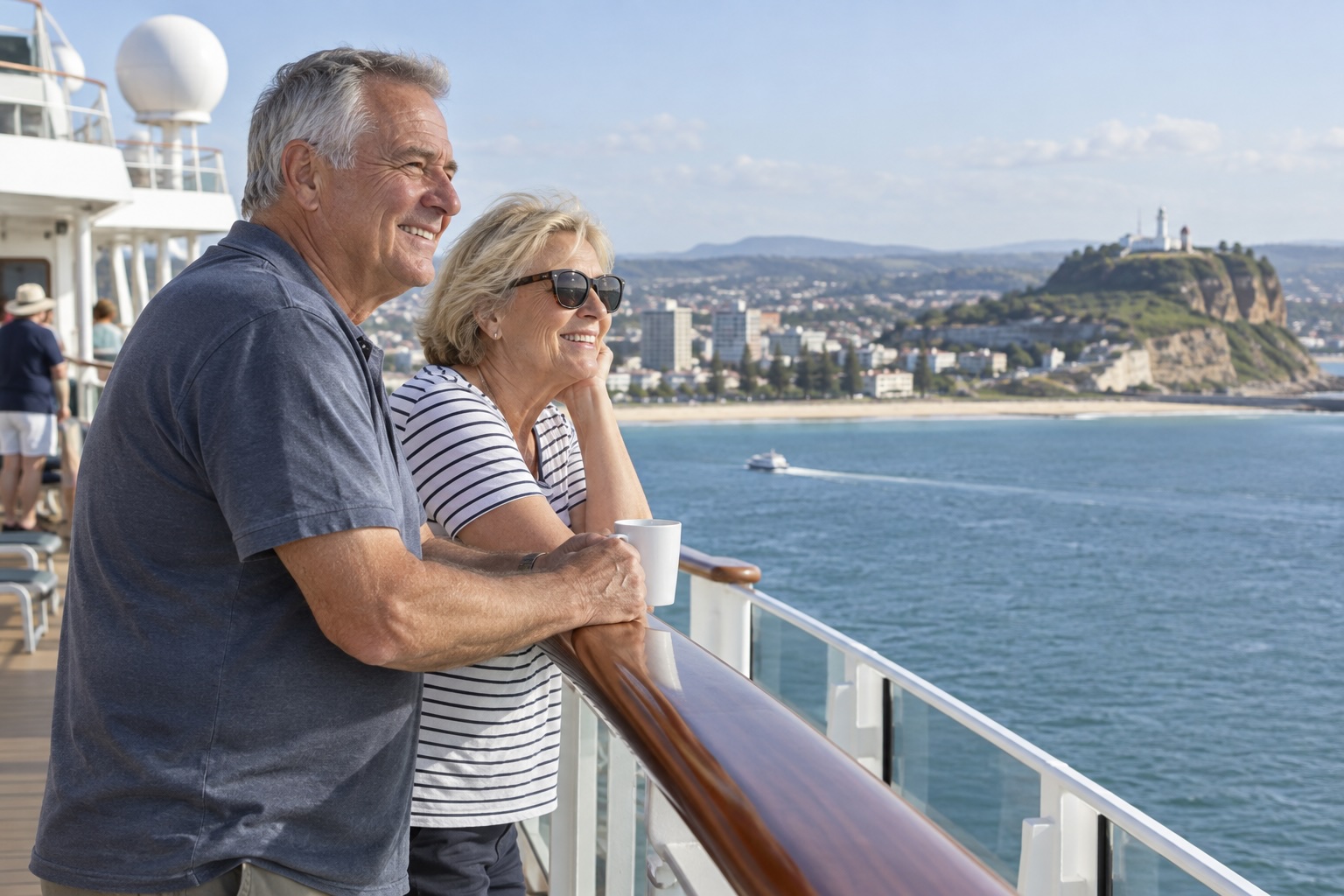
Why Medicare generally doesn’t cover cruise ship treatment, what cruise travel insurance can cover and what to check before sailing.
More than a million Australians took a cruise last year. A great many of them stepped aboard believing Medicare was still looking after them. It wasn’t.
There is a moment on every cruise that nobody thinks about. You walk up the gangway, hand over your card, and the ship’s photographer takes a picture you’ll probably buy later. At that moment, without anything visible changing, your medical cover changes completely.
It is one of the least understood facts in Australian travel, and it catches out the most experienced travellers as often as the first-timers — because the assumption underneath it is so reasonable. The ship is right there at the wharf. You can see the Harbour Bridge from the deck. How could you possibly not be covered?
Here is how.
Does Medicare cover you on a cruise ship?
Generally, no. Doctors working on cruise ships do not need Medicare provider numbers to treat you, and most do not have them. If a ship’s doctor treats you, you usually cannot claim on Medicare or on your private health insurance — even if the ship has not left Australian waters. The Australian Government’s Smartraveller service advises taking out travel insurance for any cruise, domestic or international.
That is not a technicality or a loophole. It is how the system is built, and Smartraveller states it plainly: “If your cruise isn’t leaving Australian waters, you still need travel insurance for your health. You may be unable to claim Medicare or private health insurance on the ship. Check before you go if your ship has a Medicare-accessible doctor on board.”
The CHOICE travel insurance buying guide, published on the Smartraveller site, puts it even more directly: doctors working on cruise ships don’t need Medicare provider numbers to provide medical care, and if they treat you, you can’t claim on Medicare or your private health insurance — even in Australian waters.
Why a domestic cruise isn’t domestic travel
Most cruise ships sailing from Australian ports are registered overseas. That registration is what governs the medical services on board, not the water the ship happens to be floating in.
So a Sydney-to-Sydney sailing, or a short break up to the Whitsundays and back, is not domestic travel as far as your health cover is concerned. You never leave the country, you never show a passport, and you are nonetheless outside the system you have paid into your whole working life.
This matters more than it used to, because this is exactly the kind of cruise Australians are taking. Cruise Lines International Association’s Source Market Report for 2025 found a record 1.45 million Australians took an ocean cruise that year, up 9.5 per cent on 2024 — and 80.3 per cent of them sailed in Australia, New Zealand and the South Pacific.
Four in five Australian cruisers are staying close to home.
Close to home, and outside Medicare.
What onboard medical care actually costs
Ships carry a doctor and usually a nurse. The medical centre is a genuine clinic and the staff are properly qualified. What it is not is a bulk-billing GP.
Consultations, medications, dressings, X-rays and any treatment are billed privately, generally to your onboard account, and generally payable before you disembark. There is no rebate to claim afterwards from Medicare, and your private health fund will not help either.
For a sprained wrist or a course of antibiotics, that is an annoyance. For anything more serious, it stops being an annoyance quite quickly — because a ship’s medical centre is designed to stabilise, not to treat.
The scenario that turns a bad day into a very expensive one
A ship’s clinic typically has an X-ray machine, some diagnostic capability and a small number of beds. It does not have a cardiac catheter lab, a stroke unit or an operating theatre for anything beyond the minor.
So if something serious happens — a cardiac event, a stroke, a fall with a fracture, a case of appendicitis — the doctor’s job is to keep you stable and get you off the ship.
That means one of two things. Either the ship diverts or waits for the next port and you are transferred to a hospital there, or, if it cannot wait, you are evacuated.
Smartraveller is blunt about what the second option costs: “The cost of medically evacuating a patient from a cruise ship by helicopter can be in the $100,000s.”
And there is a second cost sitting behind the first. Once you are off the ship in a regional port, you still have to get home — and if your travelling companion goes with you, so do they. Your cruise fare, your flights home, your accommodation while you recover: none of it is refundable simply because you got sick.
What cruise travel insurance covers that a standard policy doesn’t
Here is the part that catches out even people who bought insurance.
Many travel insurance policies exclude multi-night cruising from their standard cover. Cruise cover is frequently a separate selection — an add-on or pack you choose when you buy — rather than something included because you ticked “comprehensive”.
If you bought a policy for your cruise and did not specifically select cruise cover, it is worth checking what you actually hold. This is not a rare mistake; it is one of the most common ones in the category.
Cabin confinement
If the ship’s doctor confines you to your cabin — most often for a gastrointestinal illness — cruise cover typically pays a daily benefit for each day you’re stuck there. It is not a large sum, but it recognises something a standard policy doesn’t contemplate at all: that you have paid for a holiday you are now spending in a windowless room.
Missed ports and itinerary changes
Weather reroutes ships. Cruise-specific cover can respond when the itinerary changes and you lose pre-paid shore excursions, or when you miss the ship’s departure for a covered reason.
Medical evacuation at sea
The big one. Evacuation from a vessel is logistically and financially different from an ambulance ride, and it needs to be specifically covered.
Six things to check before you sail
- Does your policy cover multi-night cruising, or is cruise cover a separate selection you need to make?
- Does it cover the sailing you’re actually taking — including a domestic one, and including river cruising if that’s your trip?
- Is medical evacuation at sea included, and is there a limit on it?
- What is your cancellation cover set to? Cruise fares are large and paid early. Cover set to a token amount protects a token amount.
- Are your shore excursions covered, including anything more active than a coach tour?
- Does the ship have a Medicare-accessible doctor? Smartraveller specifically recommends asking. In most cases the answer is no — but it costs nothing to ask your cruise line.
Cruising is, on almost every measure, one of the safest and easiest ways for Australians over 60 to see the world. Nothing here argues otherwise.
But the thing that makes it feel safe — the ship, the crew, the sense that you never really left — is precisely the thing that makes the insurance gap so easy to miss. The gangway is a border. It just doesn’t look like one.
Planning a cruise? Get a price for your trip with Travel at 60 Insurance, including cruise cover for ocean and river sailings. Most people have a number in under two minutes. Cover options, limits and exclusions are set out in the Product Disclosure Statement. Get my quote →
Frequently asked questions
Do I need travel insurance for a domestic cruise in Australia? Smartraveller recommends travel insurance for any cruise, domestic or international, because you may be unable to claim Medicare or private health insurance for treatment on board. Most ships do not carry a Medicare-accessible doctor.
Does Medicare cover a ship’s doctor? Only if the doctor is registered with Medicare and you are travelling between two Australian ports. Most cruise ship doctors are not Medicare-registered, so in practice the answer is usually no.
Is cruise cover included in comprehensive travel insurance? Not always. Many policies treat multi-night cruising as a separate selection. Check your certificate of insurance rather than assuming “comprehensive” includes it.
What is cabin confinement cover? A daily benefit paid if the ship’s doctor confines you to your cabin because of illness. Conditions, minimum periods and limits vary by policy.
Does travel insurance cover river cruises? Some policies include river cruising in standard cover and some treat it as a cruise requiring the cruise selection. It is worth confirming for your specific sailing.
Information in this article was accurate as at 9 September 2026.
References
- Smartraveller (Department of Foreign Affairs and Trade), Going on a cruise
- Smartraveller / CHOICE, Travel insurance buying guide: What are you covered for?
- Cruise Lines International Association Australasia, Source Market Report 2025, released April 2026
- Butter International Travel Insurance combined Product Disclosure Statement and Financial Services Guide
Travel at 60 Insurance is issued by Butter Insurance Pty Ltd (ABN 52 651 061 362, AR No. 1300855), an Authorised Representative of battleface Insurance Services Pty Ltd (ABN 28 650 606 045, AFSL 536280), and is underwritten by Pacific International Insurance Pty Ltd (ABN 83 169 311 193, AFSL 523921). [Travel at 60 entity name] is an Authorised Representative (AR No. [PENDING]) of battleface Insurance Services Pty Ltd.
Any advice provided is general advice only and does not take into account your objectives, financial situation or needs. Before acquiring this product, please consider the Product Disclosure Statement (PDS), Financial Services Guide (FSG) and Target Market Determination (TMD) to decide whether it is right for you. Terms, conditions, exclusions, limits and sub-limits apply. Not all benefits apply — some covers are optional and apply only if selected and shown on your Certificate of Insurance.