
Medicare doesn’t travel: what a reciprocal health care agreement really covers

Scott Podmore
Travel writer
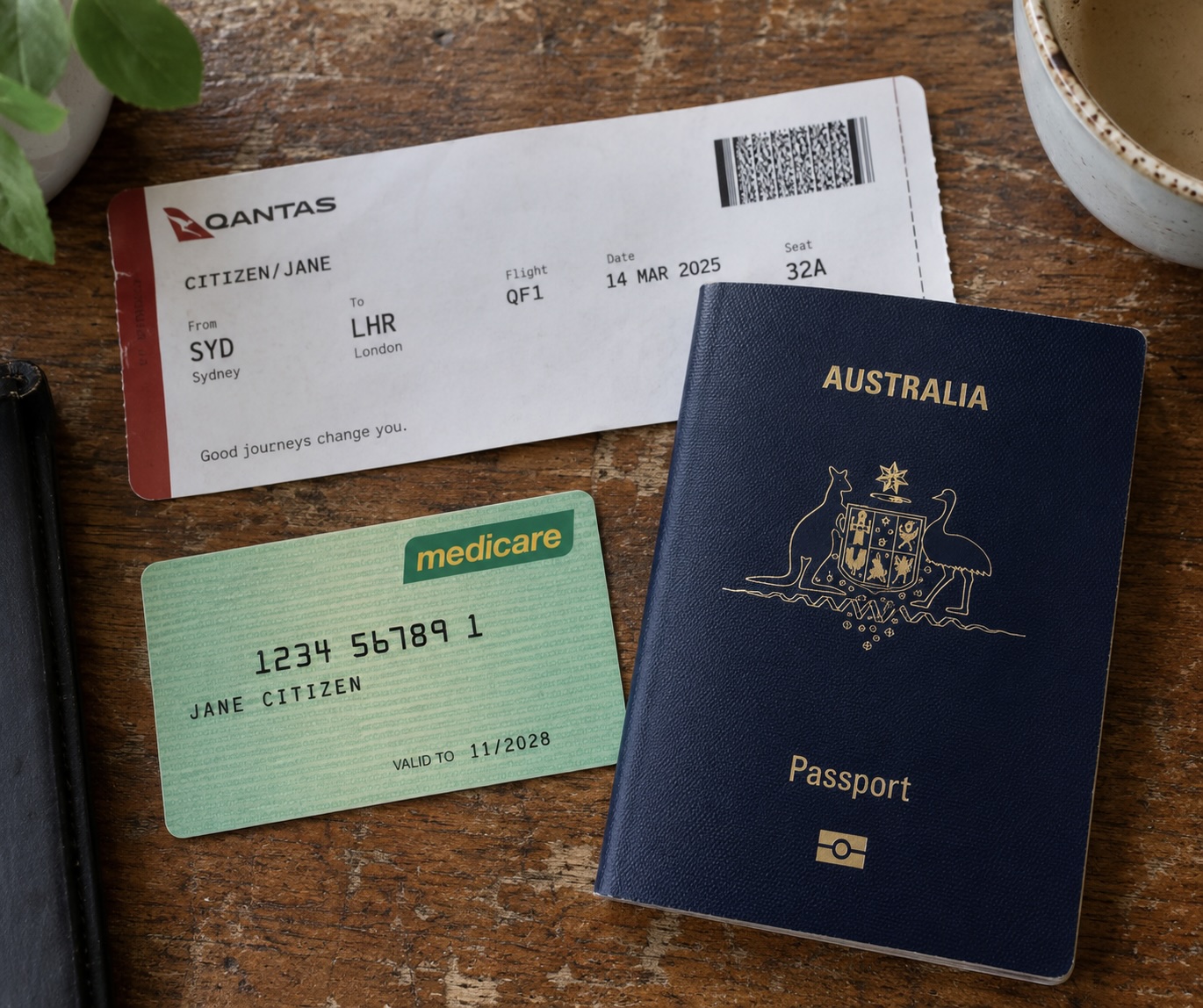
Australia’s reciprocal health care agreements offer limited help in 11 countries, but leave important medical and travel costs uncovered.
Australia has health agreements with 11 countries. They are genuinely useful, widely misunderstood, and no substitute at all for travel insurance.
It comes up in conversation before almost every European trip. Someone mentions travel insurance, and someone else says the thing that sounds reassuring and is only half true.
“You don’t need to worry in the UK — we’ve got an agreement with them.”
There is an agreement. Australia has eleven of them. And they will do considerably less for you than most people assume.
This is worth getting straight, because the gap between what people think a reciprocal health care agreement does and what it actually does is where the expensive surprises live.
Which countries have a reciprocal health care agreement with Australia?
Australia has reciprocal health care agreements with 11 countries:
- Belgium
- Finland
- Italy
- Malta
- The Netherlands
- New Zealand
- Norway
- The Republic of Ireland
- Slovenia
- Sweden
- The United Kingdom
These agreements provide some emergency care to Australians, usually limited to treatment that is urgent and medically necessary, and most require a co-payment from the patient.
Look at that list closely, because what is missing from it matters more than what is on it.
There is no agreement with the United States. None with Japan, Canada, Indonesia, Thailand, Singapore, Vietnam, France, Spain, Germany, Greece, Fiji, Vanuatu or anywhere else in the Pacific.
France, Spain and Greece are not on the list. Neither is most of Europe. The agreement covers a specific set of countries and travelling near one of them does nothing for you.
What a reciprocal health care agreement covers
Where an agreement does apply, it can cover or subsidise some emergency medical costs — usually urgent treatment that cannot wait until you get home. Some agreements extend to local medical transport, medication or specialist services.
Two important qualifiers, both from Smartraveller.
Each country decides for itself what it will cover, and the Australian Government cannot intervene in another country’s processes. And subsidised is not the same as free. Most agreements expect you to pay a percentage of the cost yourself.
The treating doctor in that country decides whether your condition counts as a medical necessity. Not you, and not the Australian Government.
What it doesn’t cover, and this is the important part
Smartraveller sets this out clearly. Reciprocal health care agreements:
- do not cover all medical situations — they are usually for urgent care that cannot wait until you get home
- do not pay your total medical costs — most expect a co-payment
- do not pay for private health care — you pay the full cost
- do not cover non-subsidised medicines or treatments
- do not cover non-urgent medical needs
- are not a substitute for travel insurance
That last line is not our interpretation. It is the Australian Government’s own wording.
The three costs no government arrangement will ever pay
If you take one thing from this article, make it these.
Medical evacuation. Getting you from where you are to a hospital that can treat you. Smartraveller states plainly that evacuations “often cost 1000s of dollars” and that they “aren’t covered by reciprocal health care agreements”.
Repatriation. Getting you home to Australia afterwards, which for anyone who cannot fly commercially means an air ambulance.
Getting your companion home with you. If your partner has to come home early with you, those changed flights are yours to pay for.
An agreement can stop you being turned away at the door of a public hospital. It will not fly you home. Those are entirely different problems and only one of them is solved.
Does Medicare cover you overseas at all?
No. Medicare covers medical treatment in Australia. Once you leave, it stops.
Smartraveller is direct about what happens if you have no insurance: “The Australian Government can’t pay your bill or loan you money… you’ll have to pay the full cost of your emergency medical care yourself.” If you cannot pay, the advice is to contact family and friends at home for money.
There is one further reality check worth having. Research commissioned by the Insurance Council of Australia and DFAT’s Smartraveller in 2025 found that 74 per cent of travellers expected government assistance in circumstances where the government may not be able to provide it — including coordinating and paying for medical evacuation or treatment.
Three in four of us are relying on something that isn’t there.
What about private health insurance?
Also no, in almost all cases. Australian private health insurance is designed for the Australian health system. A small number of funds offer separate overseas products, but a standard hospital and extras policy does nothing for you in Rome or Denpasar.
Where this leaves the places Australians over 60 actually go
Run the list against a typical retirement travel calendar and the picture is uneven.
The United Kingdom and Ireland — agreement applies. Useful for urgent public treatment, and no help at all with getting home.
Italy, the Netherlands, Belgium, Malta, Finland, Norway, Sweden and Slovenia — agreement applies, with conditions that vary country by country.
France, Spain, Germany, Greece, Portugal, Croatia — no agreement. This surprises people, because a European itinerary rarely stays inside one country and the agreement does not travel with you across the border.
New Zealand — agreement applies, which is why a lot of Australians assume a New Zealand trip needs nothing. Urgent public treatment is one thing; a cancelled trip, an air ambulance or a hire car excess is another.
Fiji, Vanuatu, Samoa, New Caledonia, the Cook Islands — no agreement, and these are among the destinations Australians over 60 are booking most heavily right now. Medical costs are paid up front, and evacuation from a small island is expensive precisely because it is remote.
Bali, Thailand, Vietnam, Japan, the United States — no agreement anywhere.
None of this is an argument against travelling. It is an argument for knowing which of the two questions you have actually answered. “Will a hospital treat me?” and “who pays to get me home?” have very different answers, and only the second one has ever bankrupted anybody.
Heading overseas? Get a price for your trip with Travel at 60 Insurance, including unlimited emergency medical cover and 24/7 emergency assistance. Most people have a number in under two minutes. Cover options, limits and exclusions are set out in the Product Disclosure Statement. Get my quote →
Frequently asked questions
How many countries have a reciprocal health care agreement with Australia?
Eleven: Belgium, Finland, Italy, Malta, the Netherlands, New Zealand, Norway, the Republic of Ireland, Slovenia, Sweden and the United Kingdom.
Does Medicare cover me in New Zealand?
New Zealand has a reciprocal health care agreement with Australia, which can cover medically necessary public treatment. It does not cover repatriation, private treatment or your cancelled travel arrangements.
Do I still need travel insurance if I’m going to an agreement country?
Yes. Smartraveller states that a reciprocal health care agreement is not a substitute for travel insurance, particularly because evacuations are not covered.
Does Medicare cover me in Bali or Thailand?
No. Australia has no reciprocal health care agreement with Indonesia or Thailand, and Medicare does not operate outside Australia.
Will the Australian Government pay my medical bills overseas?
No. Smartraveller states the Australian Government cannot pay your bill or loan you money.
Information in this article was accurate as at 9 September 2026.
References
- Smartraveller (DFAT), Reciprocal health care agreements, last updated 5 February 2026.
- Services Australia, Reciprocal Health Care Agreements.
- Smartraveller (DFAT), Getting urgent medical care overseas, updated 28 April 2026.
- Insurance Council of Australia and DFAT Smartraveller, Travel Insurance Survey 2025, Quantum Market Research, n=1,001.
Travel at 60 Insurance is issued by Butter Insurance Pty Ltd (ABN 52 651 061 362, AR No. 1300855), an Authorised Representative of battleface Insurance Services Pty Ltd (ABN 28 650 606 045, AFSL 536280), and is underwritten by Pacific International Insurance Pty Ltd (ABN 83 169 311 193, AFSL 523921). [Travel at 60 entity name] is an Authorised Representative (AR No. [PENDING]) of battleface Insurance Services Pty Ltd.
Any advice provided is general advice only and does not take into account your objectives, financial situation or needs. Before acquiring this product, please consider the Product Disclosure Statement (PDS), Financial Services Guide (FSG) and Target Market Determination (TMD) to decide whether it is right for you. Terms, conditions, exclusions, limits and sub-limits apply.